


Last updated: May 27th, 2026
Most executives think their resume must explain what they have done. They view it as a historical document listing responsibilities and achievements.
This is a mistake.
You are not a journalist. Don’t attempt to write a Pulitzer-level, balanced piece of prose that presents the reader with raw and unbiased facts, allowing them to reach their own conclusion.
Your resume is not a chronological recap of your work history.
It is a piece of forward-looking propaganda (or, if you prefer a more polite term – “marketing”).
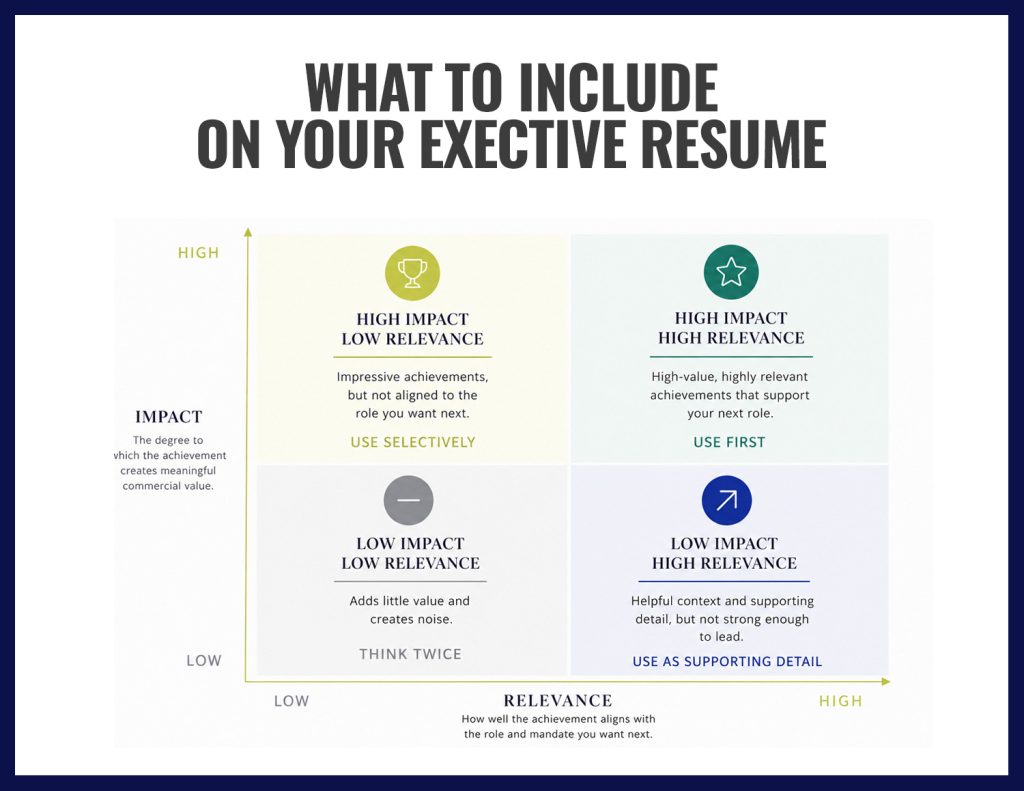
Above: Use this 2X2 matrix to highlight the most relevant, impressive parts of your background.
Its job is to shape a reader’s perception of you – by presenting a strategic narrative that positions you as the answer to a specific business point.
In other words, your resume needs to explain what your career means.
Expert Tip.
Want to ensure your executive resume positions you for next-level roles? Consider using my executive resume service.
The challenge is that at the senior level, your broad leadership career can mean many things:
- Are you a transformation executive?
- Are you a turnaround executive?
- Are you a scale-up executive?
- Functional or P&L executive?
- What size of business do you operate in best?
- In which industry?
Chances are, most of the above are true. And you’ll be tempted to mention all of them, positioning yourself as a jack of all trades who can do it all.
But you won’t be remembered for any of them.
Did You Know?
Studies show that the best executives have broad careers. Yet, the paradox of modern hiring is that the selection process rewards specialists. The answer is not dumbing your experience down – it’s positioning your experience in a way that allows you to get past the gatekeepers.
Senior hiring does not work like a slow, generous reading exercise. A CEO, board member or search partner will not spend 20 minutes trying to lovingly connect all the dots of your career.
Signal that you’re a low-risk, high-ROI answer to their client’s commercial challenge.
This is where the old “historical career summary” approach to resume writing fails.
Important!
An executive resume that simply documents your past makes you look generic. Replaceable.
If you indulge me in a car analogy for a moment, it makes you look like a Toyota.
There’s nothing wrong with a Toyota, you might object. It’s one of the highest-selling cars in the world. It’s reliable. Reasonably competent at everything.
And you’d be partially right. There is a time and place for a Toyota. When you want something to show up and do the exact same thing every time, without fail.
There are plenty of “Toyota-grade” executive roles out there.
They usually involve the riveting task of babysitting a group of C-players at a company that’s going precisely nowhere. You show up, clock in at 9 and clock out at 5. A bums-on-seats operation.
Important!
I’m willing to wager that if you’re reading this post, you’d rather be waterboarded in Guantanamo than spend the next three years of your life in one of these roles.
If my intuition is correct, your only choice is to craft an executive resume that helps the market understand:
- What problem you solve.
- Which differentiators make you the better pick than the other 5-10 candidates on the shortlist.
That usually means making hard choices. Some details need to be cut. Others need more weight.
Critically, your previous roles must be repositioned through the lens of your next career step.
This can be uncomfortable for senior leaders – because the more successful you become, the more you have to leave out. But a strong resume is not built by showing the fullest version of your career. It is built by showing the most commercially relevant version.
Irene






Lisa Hodges says:
I’m an Endorsed Enrolled Nurse that has had a career break to care for my family.
I’m finding it difficult to get a job since I’ve been off work.
Any tips to help get me back into the profession I love?
Steven McConnell says:
Hi Lisa, sorry to hear about the challenges. How many roles have you applied to so far? Any interviews?