
Last updated: September 14th, 2026
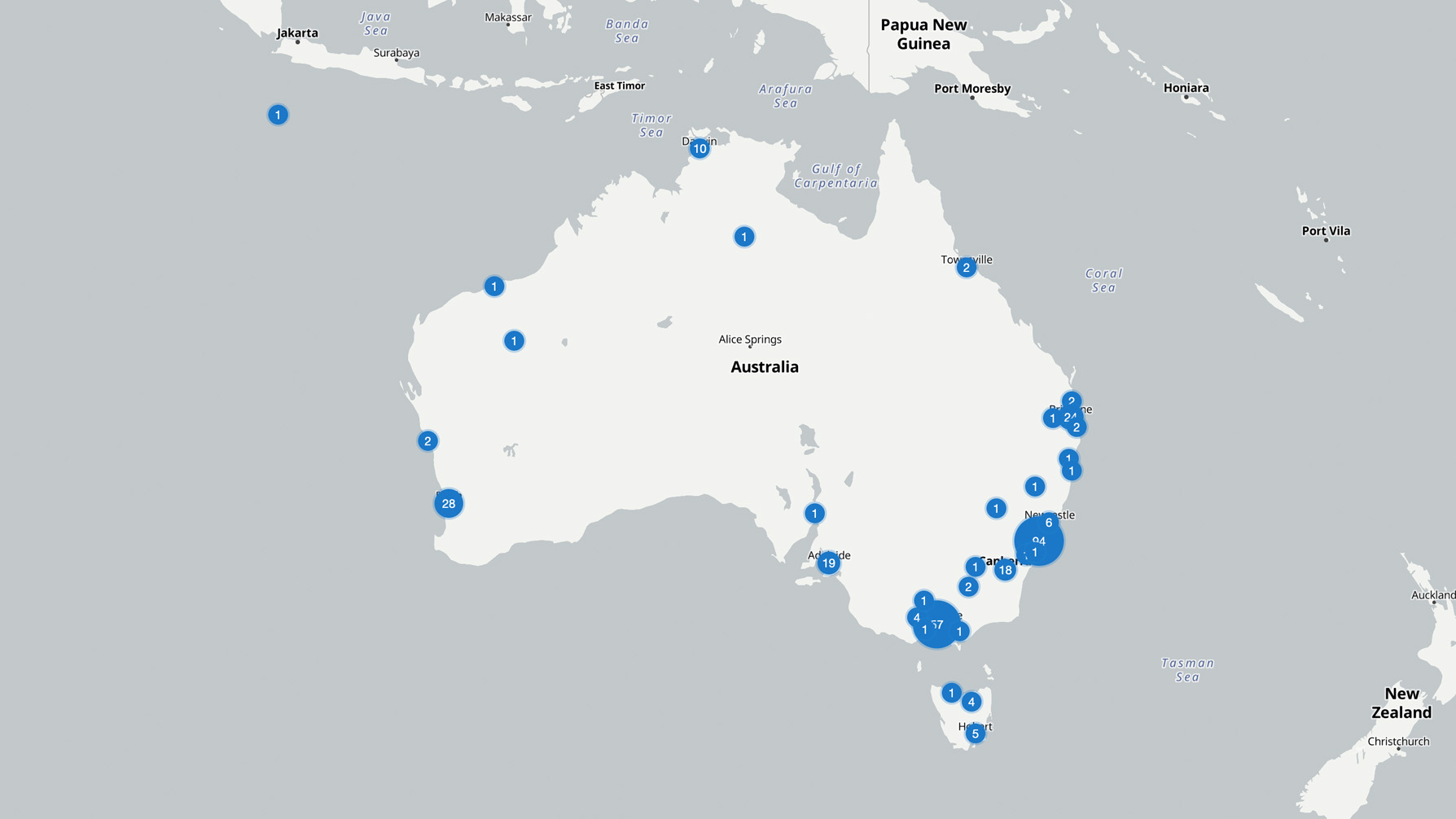
We are in a civilisational moment. The Australian AI data centre pipeline is estimated at over 150 billion, with projected capacity of 16.2 Gigawatts – or 13 times the current levels. There are already 296 of them here, mostly clustered around Sydney and Melbourne.
But there’s no shortage of controversy and conflict.
The community’s revolt against data centres is unusually bipartisan, and the Australian Labor government is figuring out how to stay elected – while keeping Australia relevant on the global stage.
A Senate inquiry is examining the effects of AI data centres on energy systems and water resources. In NSW, a parliamentary inquiry is doing the same – plus examining the effects of AI on urban planning.
Finally, the Department of Home Affairs is rolling out stricter requirements for high-risk critical infrastructure. Predictably, this includes AI data centres, power networks and water reserves.
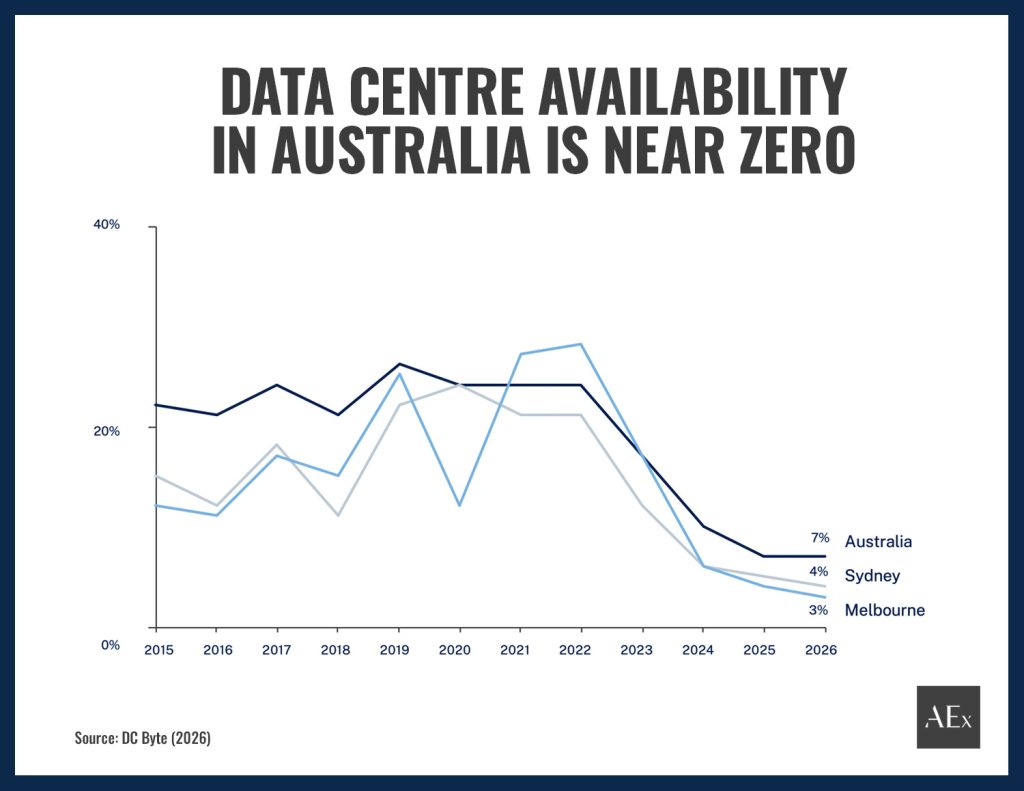
Above: Strong demand for Australian data centre capacity created a constrained supply market.
Why Is Australia In Such A Rush To Build AI Data Centres?
Asia-Pacific is evolving from a simple overflow market into a key regional player.
Instead of exporting compute back to the US, APAC countries are increasingly using AI compute locally for scientific and medical research, public services, financial services and enterprise growth.
Did You Know?
McKinsey research indicates that by 2030, APAC will account for 34% of global centre demand. North America, in contrast, will account for 46%.
Where Do AI Centres Fit In The Wider AI Value Chain?
We’re currently laying down the infrastructure that will power the next industrial revolution.
But data centres are just one element.
Jensen Huang, NVIDIA’s CEO, contextualises the role of data centres in the AI tech stack by using a “5-layer cake” analogy.
| Layer Number | Layer Name | Why It’s Important |
|---|---|---|
| 1 | Energy | Essential for running AI workloads. |
| 2 | Chips | GPUs capable of parallel processing create AI tokens. |
| 3 | Infrastructure | Data centres, AI factories and their vendors. |
| 4 | AI Models | Where most people assume AI “lives”. |
| 5 | Applications | Where end users convert AI tokens into productivity gains while capturing the economic upside. |
But Jensen’s 5-layer model doesn’t quite capture the full complexity of the AI value chain – because it ignores the role of commodity inputs at the highest level.
Rare earth minerals like germanium and gallium are indispensable for GPU chip manufacture, and arguably belong in “Layer 0”.
Australia is a key global player at this level, because of its substantial raw inputs – while China dominates the processing.
Did You Know?
Australia currently has 1.6 gigawatts (GW) of operational data centre capacity, according to DC Byte. It is set to more than double by the end of 2030 to 3.9GW.
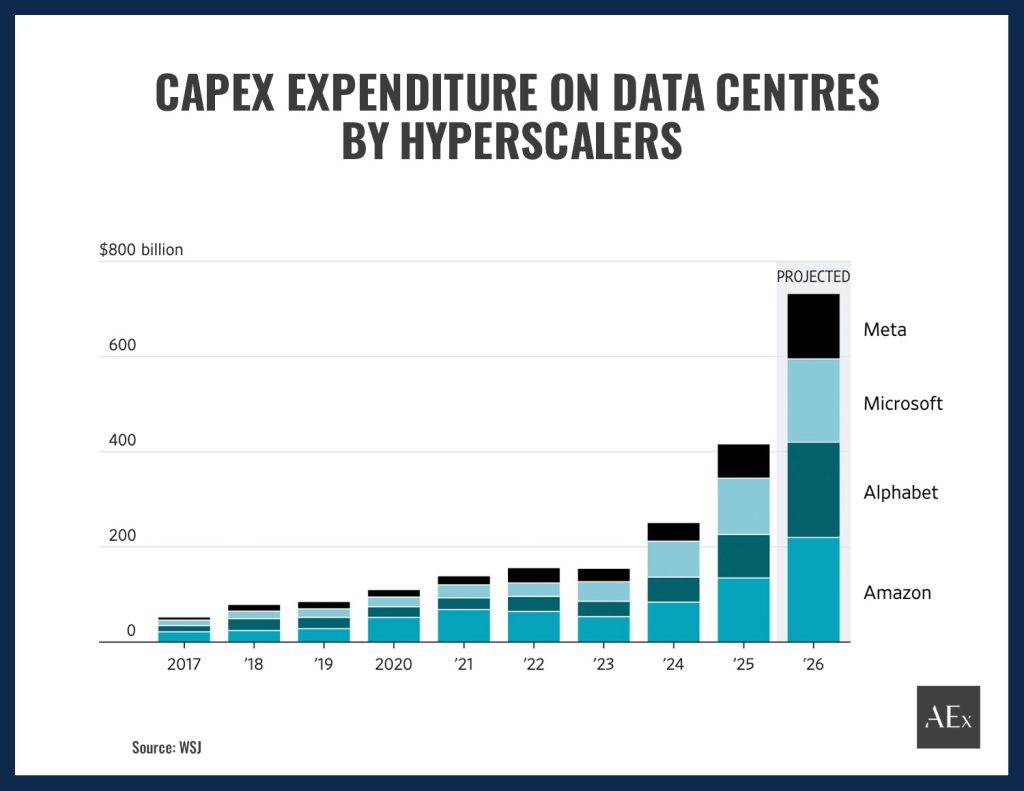
Above: Hyperscalers like Amazon and Microsoft are driving most of the AI data centre spend.
AI Factory vs Data Centre: What’s The Difference?
Australian media frequently refers to three “Australian AI Factory” darlings:
- Firmus Technologies
- Sharon AI
- ResetData
But these companies don’t belong in the same category as traditional household data centre names, like NextDC.
The latter, known as co-location services, primarily sell rack space to hyperscalers, enterprises and governments. Their value proposition is:
An AI factory, meanwhile, exists higher in the value chain.
First, it needs exponentially more power than traditional data centres. Second, it’s not merely renting out the room where another company’s computer lives.
Known as “GPU-as-a-service”, it sells the AI compute itself.
Important!
An AI factory is stocked with (usually NVIDIA) GPUs, which customers can use to either run AI-heavy workloads or to create AI tokens themselves.
ResetData, for example, is likely to provide compute to a medical research lab that needs to train a proprietary AI model, but isn’t in a position to spend $30m on GPUs.
Firmus, in contrast, provides AI workloads to frontier AI labs themselves. Its sites convert electricity and data into AI tokens.
In fact, at the start of September, Firmus signed an anchor customer agreement with OpenAI, to provide two AI factory sites, which unfortunately will be located in Malaysia.
Did You Know?
Firmus’ AI factory portfolio now has 7 sites. One Australian site is operational, as is one site in Singapore. Five more are under construction.
Is The Backlash Against AI Data Centres Valid?
Resistance to technology is not a new phenomenon.
Hysteria from both sides of the political spectrum was always predictable, and has plenty of historical precedent.
During the so-called “War Of The Currents” – with Thomas Edison on one side and George Westinghouse on the other – regular people were often caught up in fear-mongering tactics of a wider ideological conflict.

Above: Anti-electricity propaganda cartoon from 1889. Entitled “The Unrestrained Demon”, it referred to the dangers of AC current.
Of course today, we use AC current everywhere, after we’ve learned how to make it remarkably safe.
But the same pattern is playing out today in Australia with AI data centres.
Much of what you heard about data centres is oversimplified nonsense, designed for easy consumption online.
- For the far-left activists and progressives, data centres are yet another symbol of a capitalist apparatus that oppresses minorities through a “settler-colonialist white-supremacy system”.
- On the centre left, the usual suspects like the ABC are capturing easy moral high ground with grievance politics and predictable virtue-signalling tropes. Their audiences view themselves as cultural vigilantes, defending the little guy against depredations of “corrupt” elites like Elon Musk.
But the right-of-centre is no less imaginative.
- The centre right increasingly views any resistance to data centre construction as a Chinese psyop designed to throw sand in the wheels of Western progress, thereby ensuring Chinese AI supremacy. For them, anyone opposing data centre construction is a useful idiot for the CCCP.
- On the far right, the focus is – as always – on “unplugging” from the Matrix. Fearing an Orwellian AI surveillance state, these garden-variety fruit loops, with individual IQ safely in the double digits, have “awakened” to the fact that AI data centres are a control instrument of a secret satanic cabal of Jewish lizard Illuminati, controlling society from the shadows.
Do Legitimate Concerns About AI Data Centres Exist?
Yes.
Bill Toohey, Head of Macro & Strategy at Yarra Capital Management, offers one of the more sensible arguments.
He points out that imported components account for over 80% of a data centre’s cost, with only 2.5% being the physical building itself.
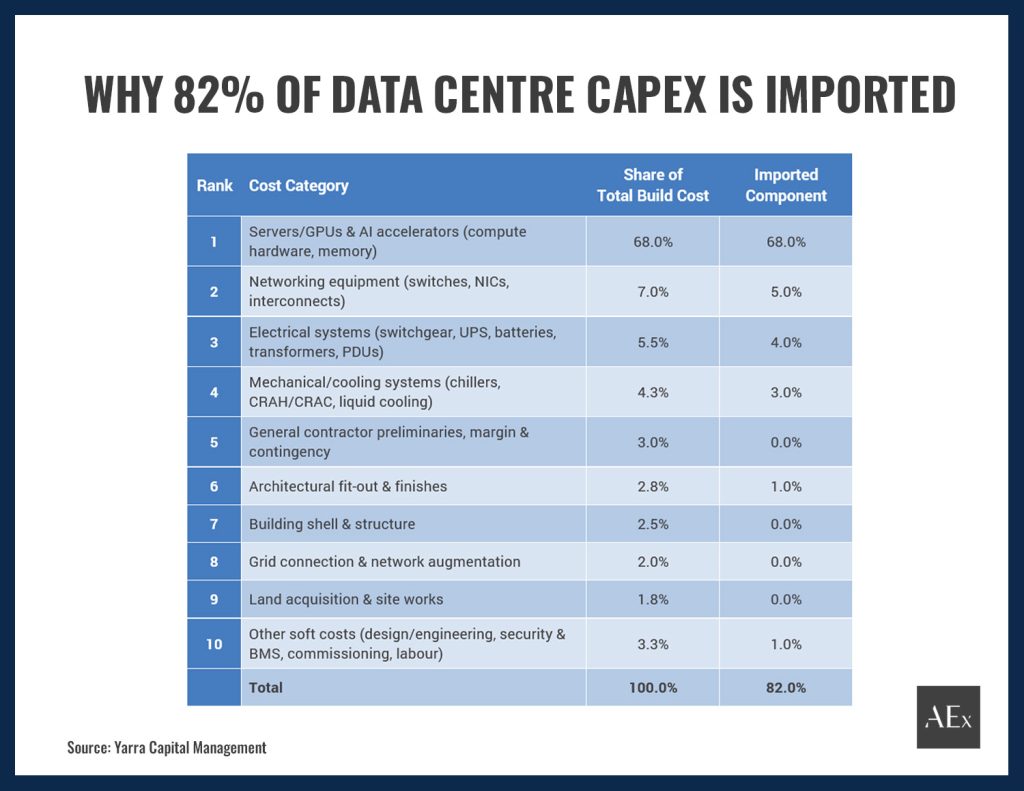
Above: Toohey’s observation creates a big wrinkle in the data centre industry’s claims.
The AI data centre industry breathlessly touts its $150 billion headline investment figure, but for Toohey, capex numbers do not translate into meaningful future economic upside for Australia.
In fact, they dramatically overstate benefits that accrue to Australia, for two reasons:
- Building “large refrigerated sheds, as Toohey calls data centres, doesn’t contribute significantly to GDP.
- Most of the economic upside will accrue to NVIDIA, offshore hyperscalers and capital investment funds.
Toohey invokes memories of the controversial Petroleum Rent Resource Tax (PRRT), which many believe “ripped off” Australia of legitimate LNG tax revenue.
His criticism is directionally correct, however he is equally guilty of omitting data to spin up a click-worthy narrative.
By narrowing his argument strictly to data centre capex, he ignores two large categories of economic benefit that data centres contribute to:
- Domestic productivity: once operational, data centres become productive capital for Australian industry.
- Infrastructure spillovers: grid, power generation, water, fibre, etc.
These are significant, but are harder to quantify – especially at these early stages.
For example, NT’s Beetaloo is transforming itself from an onshore gas producer into an integrated energy and AI infrastructure business.
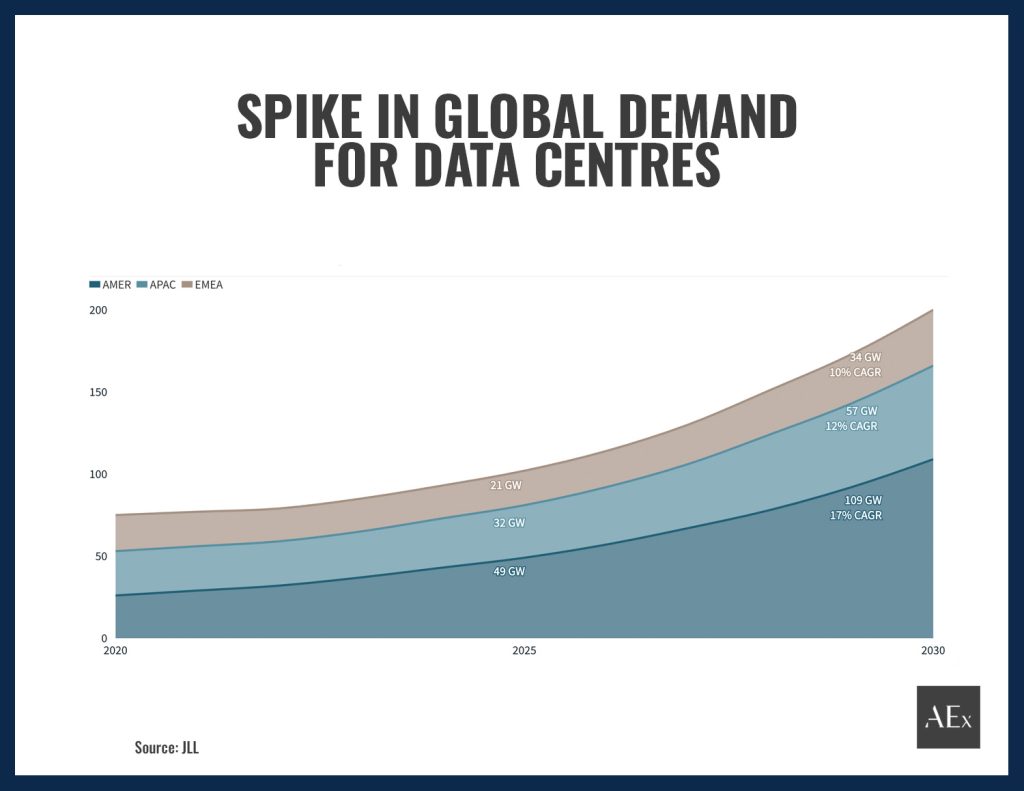
Above: The world’s appetite for data centres will continue its exponential growth until at least 2030.
Why Power Is The #1 Bottleneck With AI Data Centres.
One of the most common critiques of AI data centres in Australia is that their rapid growth will strain the grid and drive up the price of electricity.
There is some truth to this – but it’s nuanced.
A hyperscaler like Google or Amazon, or an AI factory like Firmus, can build a data centre far faster than the rest of the private sector can provide power generation and connections needed to power it.
This mismatch drives the price pressure – and worries activist types.
Did You Know?
Data centres will require 25% more power per year until 2030. This will add pressure on Australian power grids, which rely on fossil fuels for about 64% of their electricity output.
Was The Australian Government’s Response Adequate?
The federal and state governments agree that we must not plug an industrial load of this scale into the existing power grid – and let small businesses and households absorb the rising cost.
In a July 2026 speech that signalled a clear policy shift from “growth at any pace” to “conditional growth”, the PM announced that future data centre projects must match any additional power demand with sufficient levels of supply.
This reflects a broader sentiment among AI company CEOs to pace frontier AI models, and will make Australia the first country in the world to unite this obligation into a single national framework.
Important!
PM’s speech marked a significant shift in Australia’s approach to AI governance. Previously, the government was reluctant to regulate the AI industry through unified legislation, instead offering the industry voluntary instruments such as the AI Ethics Principles (2019), the Voluntary AI Safety Standard (2024) and the Guidance for AI Adoption (October 2025).
But Coalition-led Queensland and the Northern Territory governments pushed back, arguing the requirement to bring their own “100% renewable energy” – plus firming through battery storage or gas – was unreasonable.
The weeks of disagreement ended on 26th August with a compromise.
Canberra secured a commitment to a national AI standard, but backed down on demands that they must be powered by renewable energy.
“We came to a common position, which recognises that all states aren’t exactly the same, and that was accommodated in the way that we normally do, in a flexible way”, said Anthony Albanese about the apparent backdown.
The Queensland Premier declared this a win for the state and a carve-out.
Two days later, Energy Minister Chris Bowen issued a clarification – there will be no state-wide exemptions, but the Commonwealth would consider case-by-case exceptions in limited scenarios where existing coal and gas generation was demonstrably cheaper than renewables.
Did you Know?
Australia will become the first country in the world to create a whole-of-government legislative framework for regulating AI. It will include a dedicated Office Of AI within the Department of the Prime Minister and Cabinet and the establishment of a new set of mandatory Australian AI Standards.
Where Are The Australian AI Data Centres Located?
Mostly around Sydney and Melbourne.
But Raelene Lockhorst from the Australian Strategic Policy Institute has argued – convincingly – that we must build the bulk of our AI data centres in the Northern Territory.
This is an interesting proposition – because it would leverage NT’s vast space, energy resources and proximity to Asia-Pacific markets. It also sits outside the National Electricity Market (NEM) and has Beetaloo gas coming online.
Important!
It’s also a stark departure from the current strategy, with 91.3% of Australia’s planned data centre capacity to be built in NSW and Victoria.
It also offers relief from rising real estate prices.
Commercial real estate prices have soared, with data centre providers paying premiums in NSW and Victoria.
Amplifying this rise is the need for vendors that supply components to data centres to lease industrial sites nearby.
According to JLL, these companies alone have leased more than 100,000 square metres of warehouse space in the past 12 months.
Did You Know?
A 20,000 square metre warehouse in Sydney’s Outer Central West could cost 88 percent more to rent in 2027. Renting a similar warehouse in Melbourne could cost 132 percent more, according to JLL’s modelling.
Can Australia Offshore Its Data Centre Requirements?
Data centre opponents have floated the idea of moving AI compute to low-regulation countries.
This is an unlikely scenario.
Australia is increasingly viewing AI as a strategic national capability – not a narrow technological development.
The Albanese government has indicated that data centres, along with the physical infrastructure that powers them, are significant national assets that form vital components of Australia’s energy and national security strategy.
Hosting AI compute domestically gives Australia soft power in the APAC region – because it reduces our reliance on terms set by national actors with misaligned interests.
Important!
Strict data security, privacy and sovereignty requirements give Australia jurisdiction over how our physical infrastructure and data are governed. These are captured in Australia’s Security of Critical Infrastructure Act 2018 (SOCI).
Will AI Data Centres Threaten Australia’s Water Supply?
It’s unlikely, for two reasons:
- First, most projected AI centre infrastructure will use closed-loop water cooling systems. These recycle water instead of continuously tapping local water supply networks.
- Second, Australian local governments are proactively developing policies that prohibit data centres from using potable reticulated water.
Rather than responding to individual developers’ applications, local Councils are getting ahead of the demand boom with standardised policies that clearly set out expectations.
For example, in August 2026, Toowoomba Regional Council voted unanimously to disallow data centres from using water sourced from the region’s dams.
However, critics point out that AI companies aren’t transparent about their total water usage, because they don’t report consumption at power centres that feed them energy.
Of all the hyperscalers, only Meta provides water usage metrics throughout the entire chain.
Can Australia Become A Net Exporter Of AI Compute?
Australia has a unique opportunity to serve the so-called “latency-tolerant” compute from the APAC region.
Investors find Australia attractive because of its robust judicial system, skilled workforce and Five Eyes membership.
According to industry research by Data Centres Australia, Australia is unusually well placed to become an exporter of AI compute, taking advantage of the fact that not all data centre workloads need to be located next to the users they serve.
Did You Know?
The report estimates we could capture between 1.9GW and 2.9GW of demand from regional and global markets by 2030, generating between AU$2.7B and $4.1B in annual economic activity.
A typical AI data centre offers three workloads – real-time inference, batch inference and AI model training, with the latter two presenting prime export opportunities for Australia.
| Workload Type | Example | Latency | Location |
|---|---|---|---|
| Real-Time Inference | Employees using the ChatGPT chatbot | Low | Near user |
| Batch Inference | Scientist performing medical research | Flexible | Anywhere with reliable power |
| AI Model Training | OpenAI develops and fine-tunes its frontier model | Flexible | Anywhere with reliable power |
Exporting AI data centre compute also presents Australia with the opportunity to export the renewable energy embedded in it.
Important!
Data Centres Australia estimates that hosting 1.9GW of export compute in Australia would produce 3.7X lower emissions than if the same compute was hosted at Indonesian data centres.
Do Data Centres Create Jobs?
Yes and no.
Data centre build-outs create a need for the supply and maintenance of:
- Air conditioning systems.
- Uninterrupted power supply systems.
- Cooling systems.
- Plumbing and sewerage systems.
- Electrical systems.
- Data centre software.
- Security personnel.
- IT hardware and rack build-outs.
- Landscaping.
These have both direct and indirect components. The former are associated with on-site activities, while the latter have a downstream effect on the wider supply chain.
Did You Know?
The Australian data centre industry optimistically estimates that, by 2030, it will have supported 18,930 construction roles and created 23,040 ongoing jobs.
Can Repurposed Aircraft Engines Power Data Centres?
Yes.
Where do we get enough energy to reliably run these data centres?
Repurposed aircraft engines. The problem is heat. Designed to operate at cold temperatures of the atmosphere, these engines would melt if ran at sea level.
The only way to make it work is to throttle them back and spray water into them from the front. This is obviously suboptimal if the data centre is built in an area where water is already scarce.
Even jet engines that generate 42MW of electricity were proposed as an alternative.
Designed to operate at higher temperatures, these don’t require water cooling. These run on natural gas.
Can We Move AI Data Centres Into Orbit?
Potentially. Space-based data centres could untether us from the energy grid.
These would consume power from solar arrays rather than land-based power grids. They’d obtain power from space, and vent heat in space. The only thing that would come back to Earth is data.
Economics are – predictaby – brutal. SpaceX is the leader here, and it currently costs the company $2,900 to launch a kilo of payload to space. It needs to come down to about $500 to make the exercise commercially viable.
Latency isn’t an issue because satellite will stay in geostationary orbit.
Steven







Saranne Segal says:
Great article on handling workplace conflict! One factor I think should deepen the discussion further is the role of cultural differences within workplace conflicts. Many times what seems like a value conflict may actually turn out to be a cultural misunderstanding, especially in very diverse teams. Acknowledging and respecting these cultural nuances can really mean the difference between resolution and disputes and establishing an inclusive environment.
Additionally, it may help to mention the value of psychological safety. When employees feel they can speak up without repercussion, that alone can end low-level conflicts and foster more open channels of communication. This, of course, fits right in with your notes of how respect and empathy are key parts of conflict management. Thanks for illuminating an important topic and sharing your insight.
Steven McConnell says:
Thanks Saranne, you make valid points.
George Porter says:
I especially appreciated how the article links self-regulation directly to team performance—it’s rare to see that connection spelled out so clearly. Having seen teams struggle with miscommunication during high-stakes projects, I’ve noticed that leaders who pause before reacting often de-escalate tension before it impacts output. That practical cause-and-effect really resonates with what I’ve observed in real work settings.